


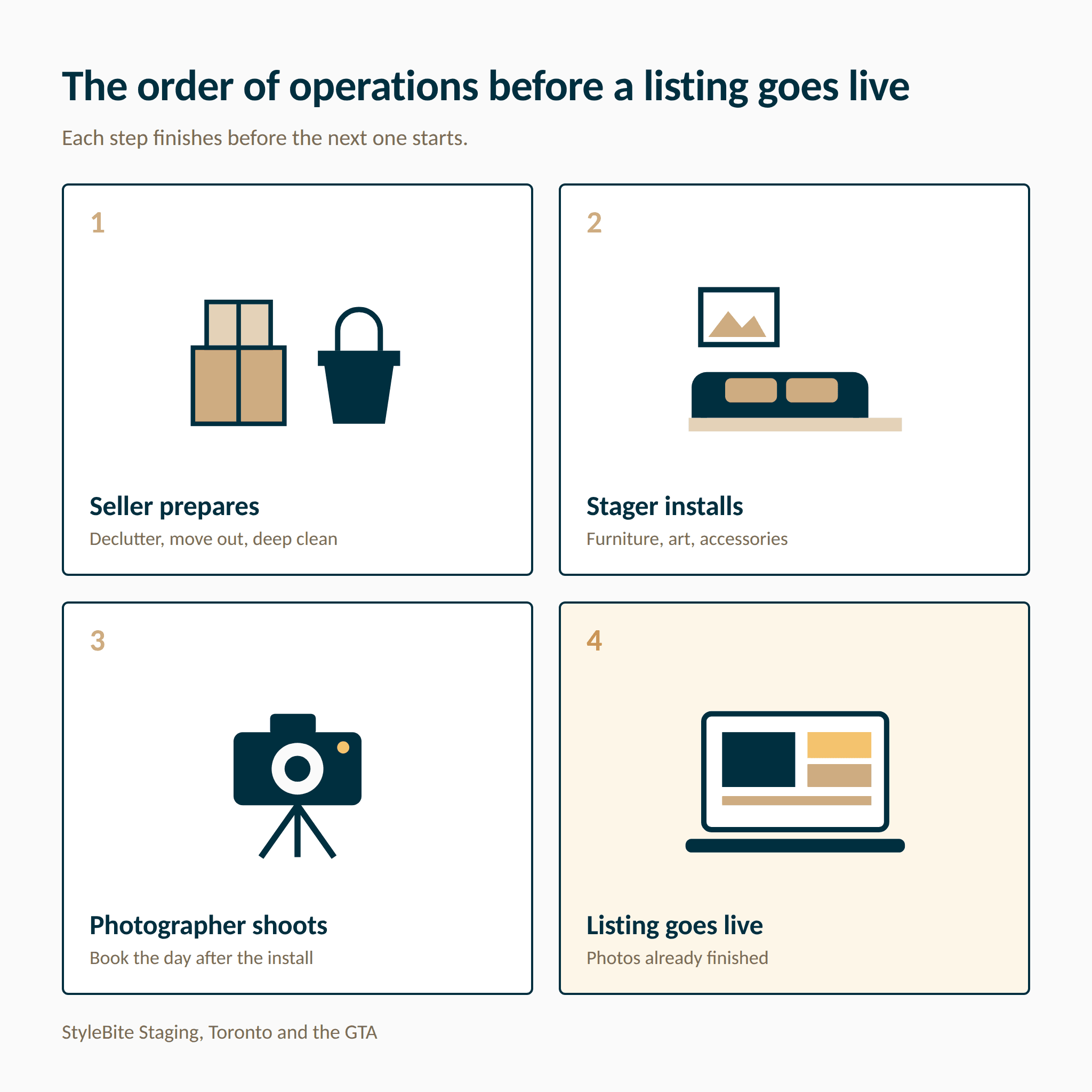
The most useful staging rule for a Toronto listing is that your deadline is photo day, not the first showing. The seller’s prep has to be finished before the stager arrives, the stager has to be finished before the photographer arrives, and the listing goes live last. After that, the decisions are where a limited budget goes, which is the living room and the primary bedroom before anything else, and how much lead time you give yourself, which depends almost entirely on how fast your seller can clear the house.
At StyleBite Staging we have staged more than 1,000 homes across the Greater Toronto Area, most of them for agents who send us listing after listing. There were 24,482 active listings across the GTA at the end of August 2026, according to TRREB, which is 4.6 months of inventory. When a buyer is comparing two similar homes at a similar price, presentation is most of what separates them, and it is the part of the listing you control.
Work backwards from photo day
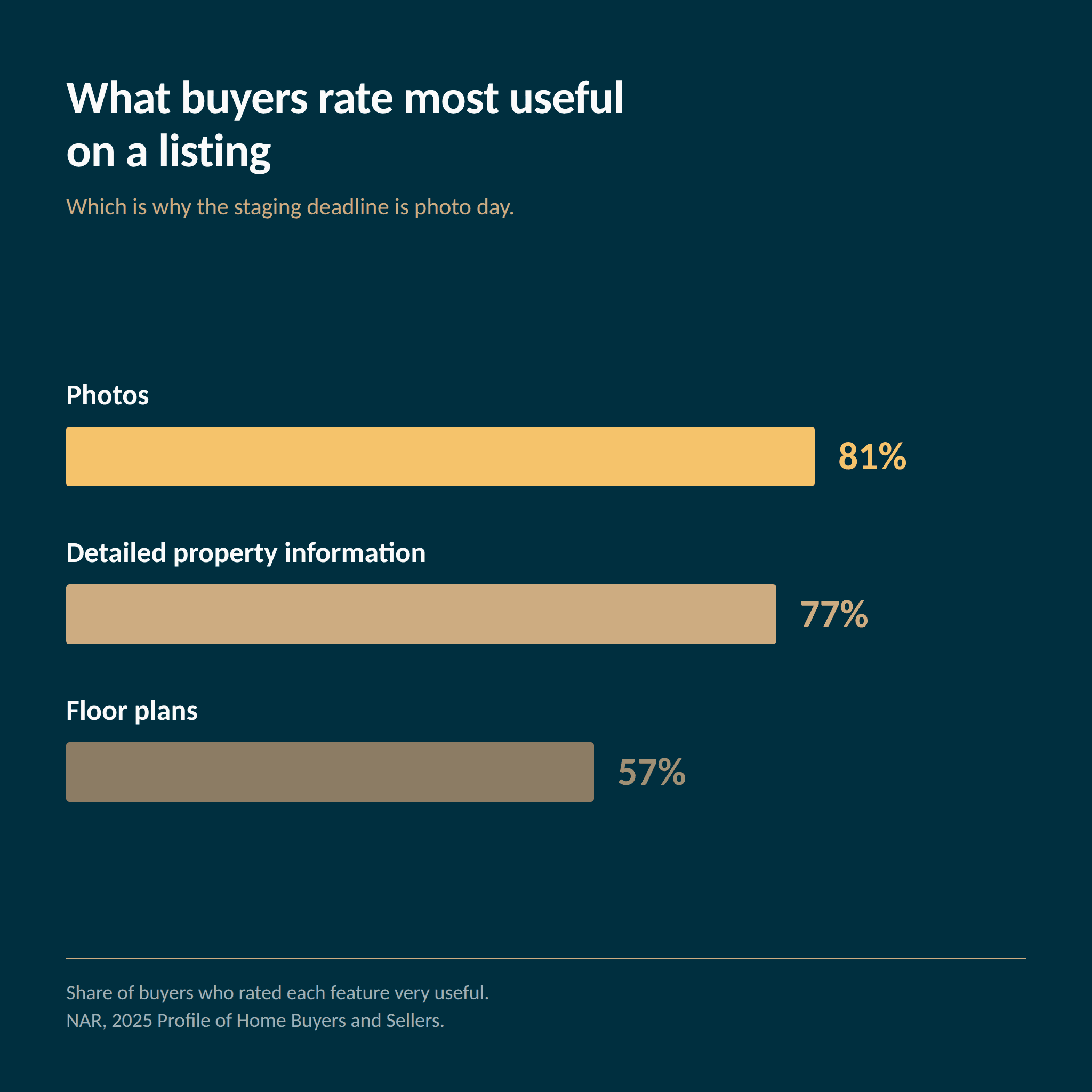
Buyers build their shortlist before they ask to see anything. In the National Association of Realtors 2025 buyer and seller survey, 52 percent of buyers found the home they bought on the internet, and photos were the listing feature they rated most useful, at 81 percent. The photos decide which homes get a showing, so the photos are what the staging is for.
That fixes your sequence. The seller finishes preparing the house, the stager installs, the photographer shoots, and the listing goes live. A common way agents lose the benefit of staging they already paid for is booking the photographer for the same morning as the install, because the team is still placing accessories while the camera is working. Book the shoot for the following day and you get the whole install in the frame.
Winter listings need one more scheduling note. Between November and February the usable daylight in Toronto is short, so book the shoot for the middle of the day and confirm with the photographer that the exterior shot fits inside that window.
Your own checklist for the day of the shoot
The stager handles furniture and styling. Everything below is the part that falls to you and the seller on shoot day, and it is the part that most often turns up wrong in the final photos:
- Clear the driveway and the street in front of the house, including your own car. Bins, hoses, toys and recycling go out of the frame.
- Sweep or salt the walkway and the front steps. The exterior shot is usually the first image in the set.
- Turn on every light in the house, including closets, the range hood and under-cabinet lighting. Replace any dead bulb first, and match the colour temperature across a room so one lamp does not photograph orange next to a white one.
- Open every window covering and take off screens where they come off easily.
- Remove pet bowls, beds, crates and litter boxes from the house for the day.
- Bathrooms: personal products off the counters, matched towels, toilet lids down, and bath mats either fresh or gone.
- Walk the house once with your phone camera before the photographer arrives. Anything that looks wrong on a small screen looks worse on a listing page.
Where the first dollar goes when the budget is small
Most sellers will fund some staging rather than a whole house. When you have to choose, follow the rooms buyers weight most. NAR asked buyers’ agents which rooms matter most to their clients, and the ranking is clear enough to allocate a budget from.
| Room | Why it earns the budget | What done well looks like |
|---|---|---|
| Living room | The most important room to stage according to 37 percent of buyers’ agents, and the room 91 percent of sellers’ agents stage. | Seating grouped around one focal point, a rug big enough that the front legs of the furniture sit on it, and one or two large pieces of art instead of a wall of small frames. |
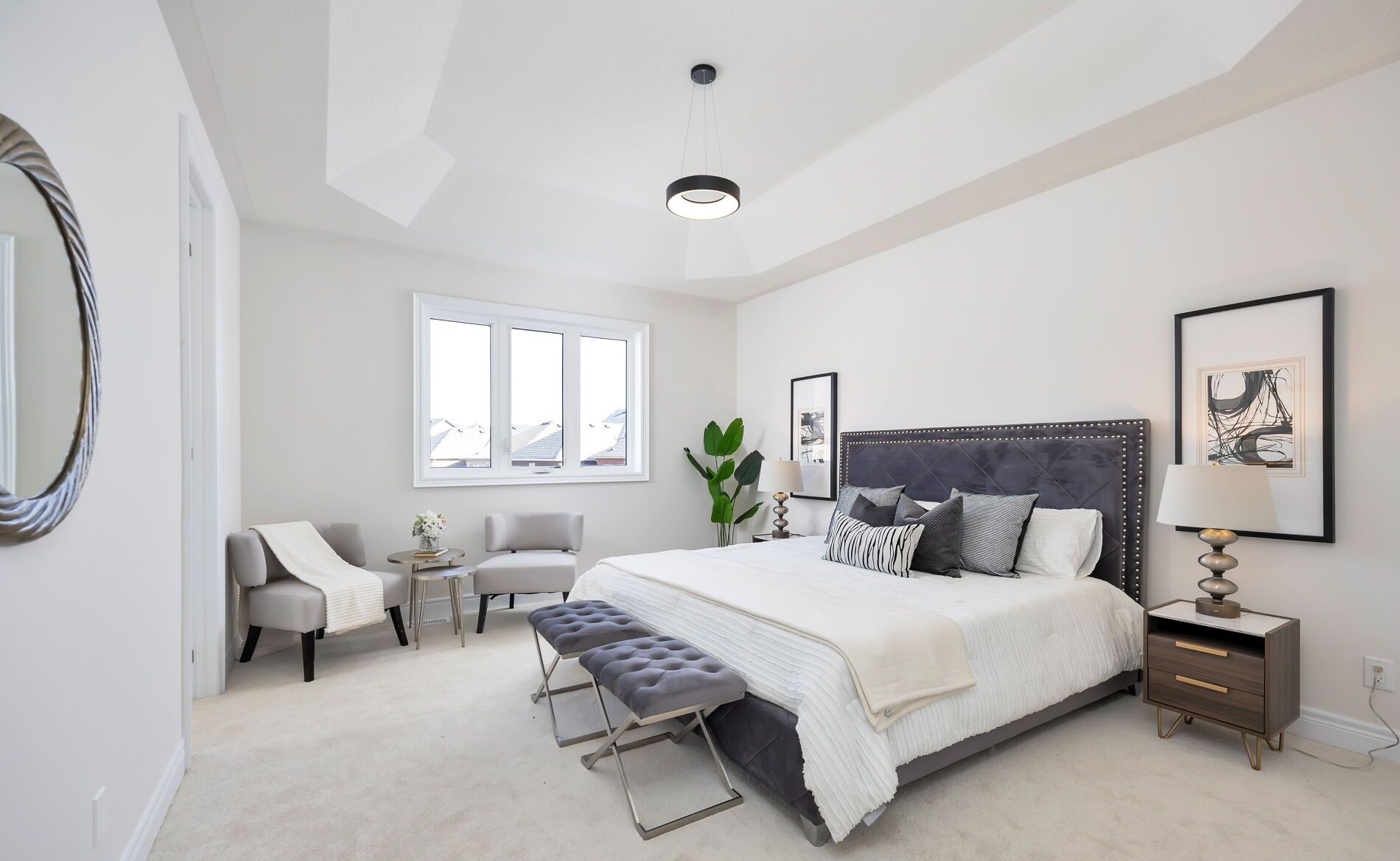
| Primary bedroom | Second at 34 percent, and staged by 83 percent of sellers’ agents. | Bed centred on its wall with plain neutral bedding, a lamp and a table on both sides, and the closet emptied to about half full so it reads as roomy. |
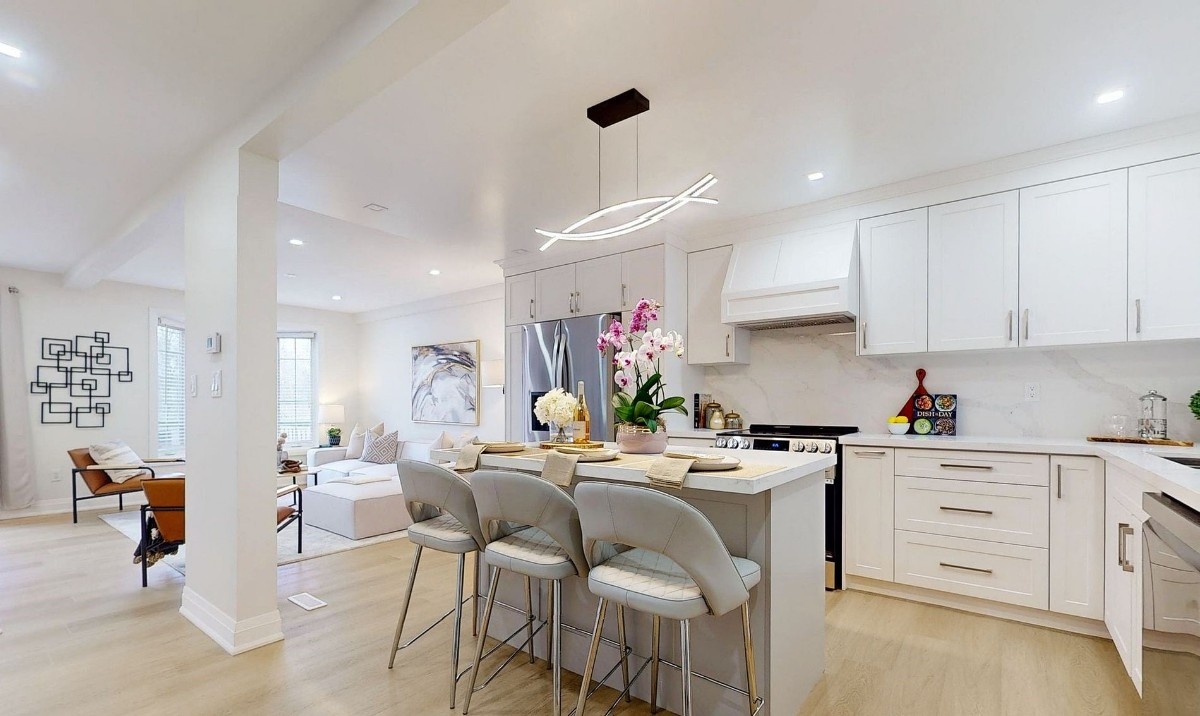
| Kitchen | Third at 23 percent. In our experience it is also the room buyers examine most closely once they are inside the house. | Counters cleared except for two or three items, the sink and drying rack empty, and dated cabinet handles replaced. New handles are one of the cheapest changes that makes a kitchen look newer. |
| Dining room | Staged by 69 percent of sellers’ agents. We stage it on nearly every project as well, because an unstyled dining room fills up with whatever the household has nowhere else to put. | Matching chairs, a light place setting for four, and nothing in the room that is not dining furniture. |
| Entry | The first thing a buyer sees in person, and often the first interior photo in the set. | Clear floor with no shoe pile, one mirror or one piece of art, and a working light. |
| Guest bedroom | Last on the buyer’s list, named most important by only 7 percent of buyers’ agents. | A bed, two side tables and a lamp. These rooms do not need to be furnished to the standard of the primary bedroom. |
If the budget covers two rooms, stage the living room and the primary bedroom. If it covers three, add the kitchen.
Secondary bedrooms are where agents argue with us, so it is worth saying where the tension actually is. NAR’s buyers’ agents put the guest bedroom last, and the same logic covers the other spare bedrooms, which is a fair reason to spend the least there. The catch is that a buyer judges the photo set as a whole. One bare or half used room in an otherwise finished set makes them wonder what is wrong with it. So do not skip those rooms and do not fully furnish them either. Put a bed, a lamp and a side table in each one, and spend the rest of the budget on the rooms at the top of the table.
Occupied listings and what the seller finishes first
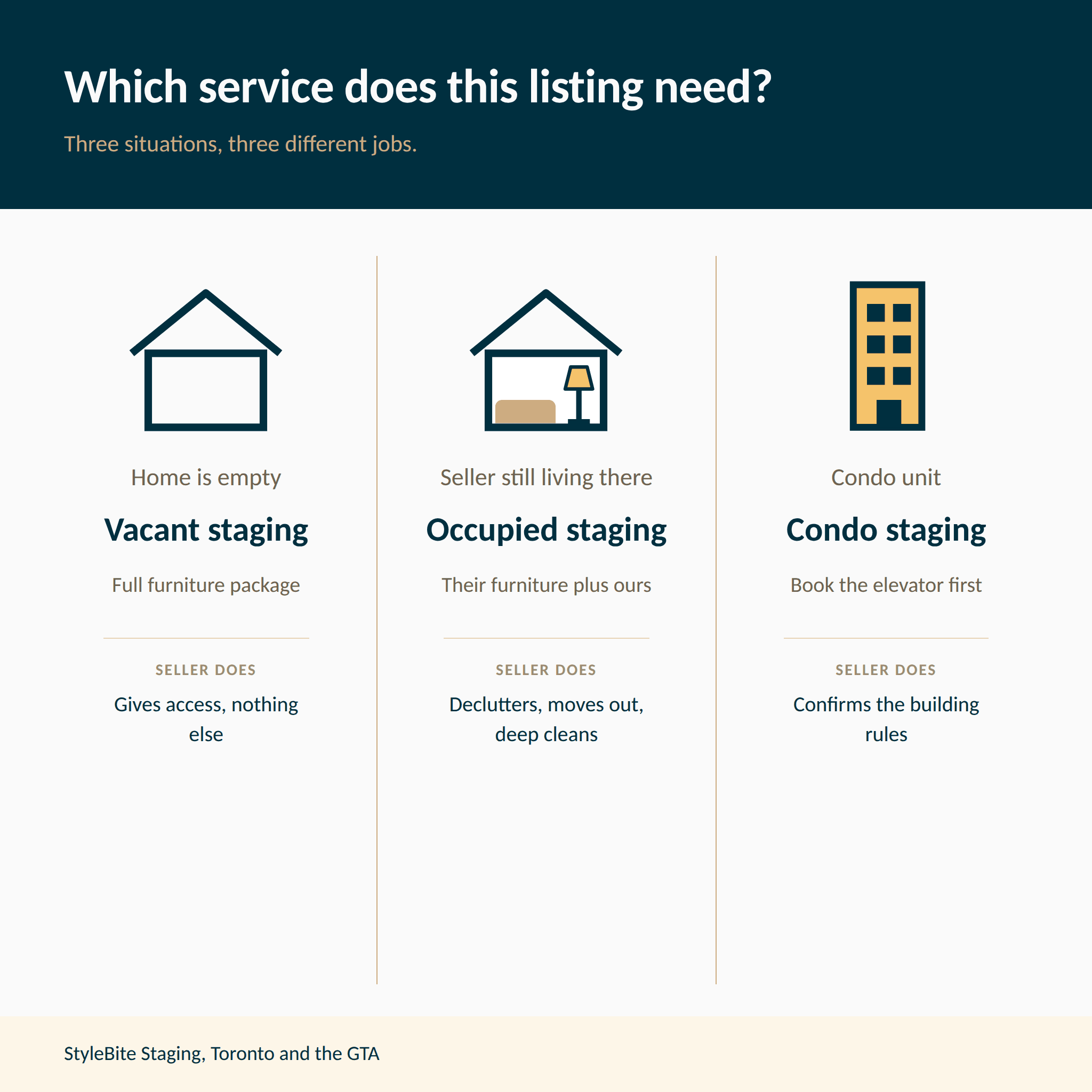
Occupied staging works with the seller’s own furniture and adds accessories and select pieces on top of it. That only works if the house is ready when the team arrives. Hand the seller this list at the listing appointment, not the week before the install:
- Declutter room by room, starting with every horizontal surface. Counters, dressers, side tables and the top of the fridge.
- Move boxes and surplus furniture to the basement, garage or a storage unit. Stagers do not move or store a seller’s belongings, and staging insurance does not cover them, so anything the seller leaves out on staging day is still there in the photos.
- Pack away family photos, diplomas, religious items and children’s artwork. A buyer who is looking at someone else’s life is having a harder time picturing their own.
- Deep clean the whole property, including windows, baseboards and grout. Accessories placed on a dusty surface photograph as accessories on a dusty surface.
- Fix the small visible things. A burnt out bulb, a running toilet, a door that sticks and chipped paint on trim all read as deferred maintenance to a buyer walking through.
- Book the photographer for the day after the install.
A house that is not ready on staging day gets a shortened install or a new date, and both of those cost the seller money. Sellers who hear that at the listing appointment usually finish the work.
There is also a low effort way to find out how much work a property needs before anyone commits to anything. For occupied homes, the seller can send us photos and a video walkthrough and we will tell them what can stay and what has to go, at no charge. It gives you something specific to put in front of the seller instead of a general conversation about occupied staging.
One last thing to pass along. Once the install is finished, have the seller photograph every styled area on their phone. They are living in the house through the listing period, and those photos are how they put a room back the way the stager left it before the next showing.
Empty rooms photograph smaller than they are
An empty room gives a buyer nothing to measure against. With no furniture in the frame there is no reference for scale, so rooms look smaller in photos than they feel in person. Damage stands out more too. A patched wall, a scuff on the floor or an off centre light fixture is the only thing in an empty frame, so that is what the buyer looks at.
Empty rooms also leave buyers guessing about function. A nook off the kitchen, a wide upstairs landing, a basement with no obvious purpose: each one raises a question the buyer has to answer for themselves, and most buyers will not put in that effort. Staging answers the question for them. The nook becomes a home office and the landing becomes a reading area, and the buyer moves on to the next photo instead of working out what they are looking at.
Vacant staging covers the full package, meaning furniture, artwork, rugs, lighting and accessories, on a design plan built around the home’s architecture, the neighbourhood and the buyer most likely to want the property. Pricing starts at $2,000 and moves with square footage and the number of rooms staged.
What changes inside a Toronto condo building
Condos need a different approach and a longer runway. The unit itself is the straightforward part. The building is what sets your dates.
- Furniture has to be scaled to the unit. A standard sofa in a 600 square foot condo makes the room look smaller, which is the opposite of what the seller is paying for, so condo staging uses pieces dimensioned for condo living.
- Light needs help in north facing units and interior rooms. Lamps, mirrors and light coloured textiles do most of that work.
- The buyer is a different person. A downtown one bedroom is usually sold to a young professional, a first time buyer or an investor, and the styling should suit that buyer.
- The building sets the install date. Book the service elevator and the loading dock first, then book everything else around what the building gives you. Every building sets its own notice period and its own move-in windows, so call property management before you commit to a listing date. This is the step that most often pushes a condo install back by a week.
Condo sellers are also working against a softer part of the market. The average GTA condo apartment sold for $617,593 in August 2026, well under the $993,410 average across all home types, and condo prices have been drifting down instead of up. A condo seller cannot count on the market to carry the sale, so the presentation of the unit is doing more of the work than it would in a rising market. Condo staging starts at $2,000, the same as vacant staging, because the furniture package and the logistics are comparable.
How much lead time to give yourself
For a vacant property, four things happen between your first call and the install:
- A visit to the property for measurements and photos.
- A signed agreement with a deposit, which holds the staging date.
- Design and inventory selection by the design team.
- The install itself, usually completed in one day.
None of those steps has a queue attached when the stager owns its inventory instead of renting from a third party. Our warehouse holds enough to stage around 50 homes at once, so nothing waits on furniture availability, and we come back with a proposal within about a day of getting the property details.
Occupied properties work differently, because the seller sets the clock. Nothing gets scheduled until the decluttering and the deep clean are done, and that is the only step in the whole process with no fixed length. It is why the staging conversation belongs at the listing appointment and not two weeks later.
One scheduling detail is worth knowing before you promise a date. The standard rental period is one month, and renewal fees apply after that. Time the install to your listing date instead of to when the seller feels ready, or the seller pays rental on furniture while the house is still being packed.
What staging costs in the GTA
| Service | What it covers | Who does the prep | StyleBite price |
|---|---|---|---|
| Consultation | A one to two hour walkthrough with a room by room assessment, a prioritized task list, paint colour recommendations, budget priorities and furniture layout guidance. | The seller does all of the work afterwards | $250, credited against the staging fee if the seller proceeds |
| Occupied staging | The seller’s own furniture plus artwork, plants, mirrors, cushions, accessories and select furniture pieces, styled by the design team. One month rental included. | The seller declutters, moves items out and deep cleans before staging day | Starts at $1,495, with the final price set by home size and the inventory needed |
| Vacant or condo staging | Full furniture package with artwork, rugs, lighting and accessories, on a design plan built for the property. One month rental included. | Nothing required from the seller beyond access | From $2,000, set by square footage, rooms staged and property type |
The consultation is the easiest place to start with a seller who is not sure yet. For $250 they get a plan they can carry out themselves, and the fee comes off the bill if they decide to go further. Our guide to home staging costs in Toronto breaks the pricing down further.
How to raise staging with a seller who thinks the house looks fine
Start with the buyer, not with the seller’s decor. Nobody responds well to hearing that their taste is the problem, and it is not the useful framing anyway. The useful framing is that the house is being presented to a buyer who has to picture their own life in it, and the staging exists to make that easy. It is a marketing decision about someone else’s reaction, not a judgement of how they live.
Then give them the numbers. The average GTA home sold for $993,410 in August 2026, and the average property that sold that month had been for sale for 49 days. On the homes we stage, sellers are usually carrying $4,000 to $5,000 a month in mortgage payments, utilities and maintenance, which works out to roughly $920 to $1,150 a week. Two weeks less on the market is $1,840 to $2,300 the seller keeps, and occupied staging starts at $1,495.
There is evidence on the price side as well, and it is worth quoting accurately. In NAR’s 2025 staging survey, 83 percent of buyers’ agents said staging made it easier for a buyer to picture the property as their future home, 29 percent of agents reported staging brought a 1 to 10 percent increase in the dollar value buyers offered, and roughly half of sellers’ agents said staged listings spent fewer days on the market. Those are agents reporting what they observed, so present them as a pattern across many sales and not as a promise about this house.
If the seller is still hesitant, the $250 consultation is a small enough step that most people say yes to it, and the recommendations that come out of it usually make the case better than any statistic.
Mistakes that cost agents money
- Booking the photographer for the same day as the install. The shoot starts before the styling is finished, and reshoots rarely happen.
- Staging over a house that was not cleaned.
- Approving a design because the seller likes it. The staging is for the buyer, and the colours a seller loves usually narrow the pool of buyers who can picture themselves in the house.
- Staging in a style that fights the house. Modern furniture in a traditional home looks wrong to buyers even when they cannot say why, and the fix is inventory that matches the architecture.
- Furnishing the main floor and leaving the bedrooms bare, which produces a photo set that stops halfway through.
- Waiting until the listing has already gone live. If a seller refuses staging and then agrees three weeks in, stage it and reshoot anyway, because new photos still work on the buyers who have not seen the listing. Just be honest with the seller that relisting partway through a campaign does not reset the clock, because TRREB’s property days on market figure carries across a relist by the same seller and brokerage.
Common questions from agents
Who pays for staging, the agent or the seller?
Both arrangements are normal in the GTA. Many agents include staging in their listing package as a cost of doing business, and many bill it to the seller or split it. We invoice whoever signs the agreement, so you and your client can settle it before the proposal goes out.
Is staging worth it on a listing under $700,000?
Usually, though the service changes. On a lower priced listing, a consultation or occupied staging tends to make more sense than a full vacant package, because the goal is to lift the photos without spending a large share of the seller’s proceeds. The rooms that get funded are the ones at the top of the table above.
What happens if the home does not sell within the one month rental period?
One month is the standard rental period on every StyleBite service, and the terms for going past it are set out in your proposal, so read them before you quote a timeline to your seller. When the property does sell, destaging takes two to four hours depending on size, every item is tracked by barcode, and the home is left as it was found.
Book staging for your next GTA listing
We work with agents across Toronto, Brampton, Markham, Mississauga, Richmond Hill, Oakville and King City, and we carry full liability insurance on every project. Send us the address, the property details and your target listing date, and we will come back with a proposal, usually within a day. If you would rather judge the work first, our before and after gallery is the fastest way to do it. Get in touch and we will get your next listing on the schedule.